
Skip to content
Facebook X Instagram
  • Contact
  • Login
Shopping Cart 0
Recovery & U
  • Home
  • Courses
  • DonateExpand
    • Faces & Voices of Recovery
Recovery & U
Current Status
Not Enrolled
Price
Free
Get Started
Log In to Enroll

Mastering Excellence: National Standards 301 is the third and final course in a three-part series on the RCO National Standards of Excellence. Building on the foundational concepts and alignment strategies explored in the first two courses, this final installment focuses on how recovery community organizations sustain excellence through ongoing evaluation and continuous improvement.

At the core of the RCO model are participation, mutuality, and trust. Just as peer-to-peer relationships are grounded in shared experience and connection, RCOs serve as a home base for recovery within the communities they support. This course reflects those values by introducing participatory evaluation, an approach that actively involves the people most connected to, and affected by, RCO programs and services.

While this course introduces more technical concepts, it does not require formal evaluation expertise. Instead, it emphasizes collaboration, shared learning, and practical reflection. Participants will explore how participatory evaluation aligns with the National Standards and supports meaningful assessment across process, implementation, and outcomes, helping organizations understand how their work is functioning, where adjustments may be needed, and how to strengthen impact over time.

By viewing evaluation as an ongoing process rather than a final judgment, RCOs can use information gathered through participation to improve services, protect the integrity of peer-based work, and remain responsive to the evolving needs of their communities.

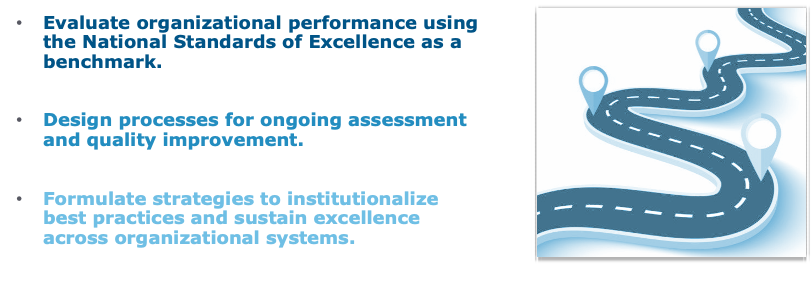
Learning Objectives
Course Content

National Standards 3.0 Pre-Test 1 Quiz
Lesson Content
National Standards 301: Pre-Test
Learning Objectives and Re-Orientation to the National Standards 1 Quiz
Lesson Content
Orientation to the National Standards Reflection Question
Participation as a Core Principle 3 Topics | 1 Quiz
Lesson Content
0% Complete 0/3 Steps
Participation as a Foundation of Participatory Evaluation
Participation and Mutuality in the RCO Context
Participation as a Bridge Between Recovery and Community
Participation Reflection Question
Foundations of Participatory Evaluation 5 Topics | 1 Quiz
Lesson Content
0% Complete 0/5 Steps
Rethinking and Reframing Evaluation
Defining Participatory Evaluation
Trust, Respect, and Lived Experience
Why Participatory Evaluation Aligns With the National Standards
Evaluation as a Tool for Learning and Improvement
Foundations of Participatory Evaluation Knowledge Check and Reflection Question
Key Areas of Organizational Evaluation 4 Topics | 1 Quiz
Lesson Content
0% Complete 0/4 Steps
Evaluating Process
Evaluating Implementation
Evaluating Outcomes
Integrating Process, Implementation, and Outcomes
Organizational Evaluation Knowledge Check and Reflection Question
The Participatory Evaluation Framework 6 Topics | 1 Quiz
Lesson Content
0% Complete 0/6 Steps
Overview of the Four Phases
Pre-Planning and Preparation
Generating Evaluation Questions
Data Gathering and Analysis
Reflection and Action
Flexibility of the Framework
Participatory Framework Knowledge Check and Reflection Questions
Stakeholders in Participatory Evaluation 3 Topics | 1 Quiz
Lesson Content
0% Complete 0/3 Steps
Understanding Stakeholders
Common Stakeholder Groups
Inclusion and Representation
Stakeholders Knowledge Check and Reflection Question
Logic Models as Planning and Evaluation Tools 3 Topics | 1 Quiz
Lesson Content
0% Complete 0/3 Steps
Why Logic Models Are Used
Core Logic Components
Timeframes, Outcomes and Alignment With Standards
Logic Models Knowledge Check and Reflection Questions
Applying Logic Models to Participatory Process 7 Topics | 1 Quiz
Lesson Content
0% Complete 0/7 Steps
Identifying the Situation
Identifying Long-term Outcomes
Identifying Medium- and Short-Term Outcomes
Reinforcing the Outcome Hierarchy
Identifying, Documenting, and Quantifying Outputs
Identifying Assumptions Explicitly
Identifying Inputs With Practical and Ethical Considerations
Applying Logic Models Knowledge Check and Reflection Questions
Continuous Quality Improvement (CQI) 8 Topics | 1 Quiz
Lesson Content
0% Complete 0/8 Steps
Introducing Continuous Quality Improvement
Plan, Do, Study, Act (PDSA)
Plan
Do
Study
Act
Applying PDSA to Feedback Processes
CQI as a Repeating Cycle
CQI Knowledge Check and Reflection Questions
Final Reflections and Takeaways 1 Quiz
Lesson Content
Final Reflection Question
Course Conclusion
National Standards 301: Post-Test

edu@facesandvoicesofrecovery.org

© 2026 Recovery & U

Scroll to top
  • Home
  • Courses
  • Donate
    • Faces & Voices of Recovery
Search